Forex trading or stock investing for beginners and which path gives a clearer edge
Want articles like this for your own video to promote it on YouTube and Google? Order them through the Telegram bot @sat_sit_bot. The bot writes and publishes the articles itself (with your YouTube video embedded) on popular topical websites (no ads). Free trial — 50 articles.
· based on the channel Matt Donlevey - Photon Trading
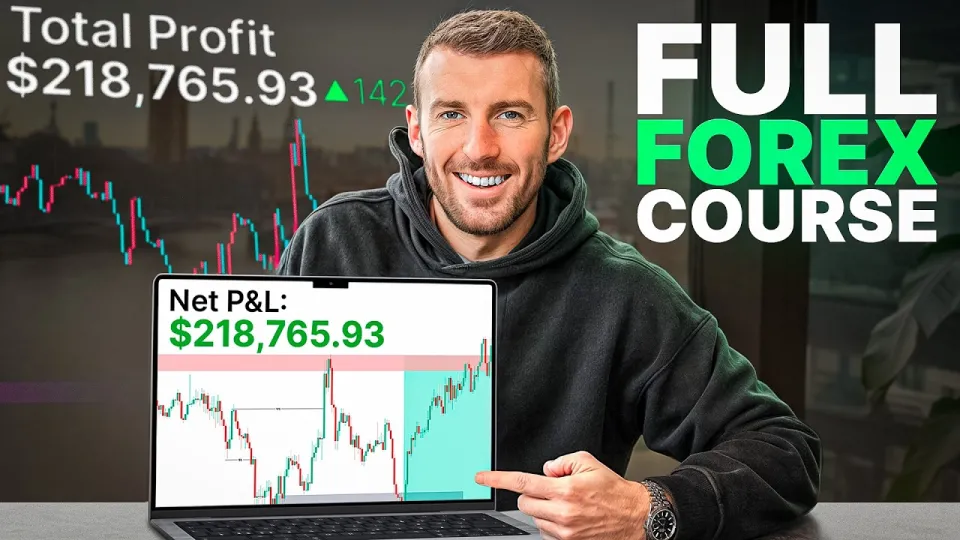
Forex trading suits beginners who want a single, highly liquid market with low entry costs and fast execution, while stocks suit people who prefer owning assets and analysing individual companies. For most newcomers the deciding factor is not the asset class but whether they have a tested strategy, a fixed risk limit and a written plan, so forex is the better first choice only if you accept that discipline as the price of entry. A free structured starting point is the Photon Trading course and cheatsheets, which pairs with the three-hour beginner walkthrough published by Matt Donlevey - Photon Trading.
What forex trading actually is and how the market is priced
Forex is the exchange of one currency for another, and every trade you place is a bet on the relative strength of two economies expressed as a pair. EUR/USD at 1.08 means one euro buys 1.08 dollars; when the quote rises, the base currency strengthened against the quote currency. The market is decentralised and runs five days a week across Sydney, Tokyo, London and New York sessions, with liquidity concentrated in the London–New York overlap.
Three mechanics decide what a trade costs you before price moves at all:
- Bid and ask. The bid is what buyers offer, the ask is what sellers want, and you buy at the ask and sell at the bid.
- Spread. The gap between the two is the broker's built-in fee, quoted in pips; a 1.0 pip spread on one standard lot of EUR/USD is roughly 10 dollars of cost.
- Order book and liquidity. Resting orders sit at prices where participants are willing to transact, and price travels from one pool of liquidity to the next rather than in smooth lines.
Understanding this microstructure matters more than drawing shapes on a chart, because a strategy built on how orders actually fill survives contact with real spreads and slippage.
Why technical analysis alone fails and what replaces it
Geometric patterns get a bad reputation because a triangle or a head-and-shoulders does not explain why anyone would buy or sell at that level. The alternative is to read market dynamics: where stop losses and pending orders cluster, which side of the auction is aggressive, and whether price is trading at a premium or a discount relative to a recent range.
Auction market theory frames this simply. Price is a continuous negotiation, and it moves quickly through areas of little interest while slowing where buyers and sellers disagree. Order flow is the record of who is hitting the market and who is resting. When you combine the two, structure stops being decoration and becomes a map of where liquidity sits.
Practical consequences for a beginner:
- Mark swing highs and lows first, then ask which side has trapped orders above or below them.
- Treat supply and demand zones as areas where unfilled orders remain, not as magic rectangles.
- Check the higher timeframe before the lower one, so a five-minute entry is not fighting a daily trend.
- Accept that a candle close is just a summary of aggression within a period, not a signal by itself.
How much money you can realistically make trading forex
Returns in forex are a function of risk per trade, win rate and payoff ratio, not of how many hours you watch charts. A trader risking 1% per trade with a 2:1 reward-to-risk ratio and a 45% win rate grinds out a positive expectancy, but the equity curve will include long losing streaks. Doubling position size to speed things up usually ends the account instead.
Worked example: a 10,000 dollar account risking 1% (100 dollars) with a 2:1 setup produces 200 dollars on a winner and loses 100 dollars on a loser. Over 100 trades with a 45% win rate that is 45 winners and 55 losers, or 9,000 dollars gained against 5,500 dollars lost — a 3,500 dollar gross result before spreads and commissions. Real numbers will be smaller, and the point is the arithmetic, not the promise.
Anyone quoting a fixed monthly percentage, or a screenshot of a small deposit turned into five figures in a week, is selling something. Funded accounts and prop capital are a legitimate route to trading larger size without risking your own savings, but they come with drawdown rules that punish exactly the behaviour beginners default to.
Building a strategy from market structure, liquidity and multi-timeframe context
The Photon approach assembles a systematic strategy from a small set of repeatable concepts rather than a pile of indicators. Market structure defines direction through higher highs and higher lows or the reverse; the framework distinguishes three structural states, from trending to ranging to transitional. Premium and discount pricing tells you whether you are buying expensive or cheap within that structure, which prevents chasing a move that has already extended.
Multi-timeframe analysis then aligns the picture: a bias from the higher timeframe, a zone from the intermediate one, and an entry trigger on the lowest. Supply and demand zones and liquidity concepts — equal highs, equal lows, session extremes — identify where price is likely to reach for orders before reversing. Entries, trade management and money management are treated as separate decisions, so a good idea is not ruined by an improvised exit.
A workable build order for a beginner:
- Choose one or two pairs, such as EUR/USD and GBP/USD, and one session.
- Define structure rules precisely enough that two people would mark the same chart identically.
- Write entry, stop and target rules as if-then statements.
- Backtest at least 100 trades on historical data and log every result.
- Forward test on a demo account before risking real money.
Common beginner questions about brokers, costs and psychology
Most early failures come from setup problems rather than from a lack of knowledge, and the audience discussion around long-form forex courses reflects that. Three themes recur: cost, speed and expectations.
Broker and costs. Compare spreads, commissions, swap rates and regulation before funding anything. A raw-spread account with a commission can be cheaper than a marked-up spread account for an active intraday trader, and the opposite is true for someone holding positions for days. Test execution on a demo account during the session you actually trade.
Pace of learning. A three-hour guide is dense, and viewers regularly note that a single pass is not enough. Watch a section, then open a chart and apply it before moving on; the material only converts into skill when it is used.
Psychology. Discipline problems usually appear after a strategy has an edge, not before. Journaling every trade — setup, risk, outcome, emotional state — turns vague frustration into data you can act on. Three mistakes show up repeatedly: risking too much per trade, moving stops to avoid a loss, and taking setups that do not match the written plan.
Useful links
- Free Photon Trading course and cheatsheets: https://www.photontradingfx.com/free-training?el=beginnersguide&htrafficsource=YT
- Photon Trading mentorship: https://www.photontradingfx.com?el=beginnersguide&htrafficsource=yt
- Free Telegram channel with analysis and trade recaps: https://t.me/photontrading
- Instagram: https://www.instagram.com/photontrading/
Bottom line on choosing forex as a first market
Forex rewards preparation and punishes improvisation, which makes it a good first market for someone willing to treat it as a skill rather than a shortcut. The mechanics are learnable in weeks, but the edge comes from a written plan, backtested rules and consistent risk of around 1% per trade. Start with the free Photon Trading course and cheatsheets, work through one concept at a time on a demo account, and only add capital once the journal shows a repeatable process. Matt Donlevey - Photon Trading is the author of the three-hour beginner breakdown this guide draws on, and its structure — market dynamics first, strategy second, psychology last — is a sensible order to follow.
Key takeaways
- Forex is the market for currency pairs such as EUR/USD, quoted as the price of one currency in another, with the spread as the built-in cost of every trade.
- Price moves because of order flow and auction dynamics, not because of geometric patterns on a chart, which is the core argument of the Photon Trading approach.
- Retail forex access is cheap, but profitability depends on a tested strategy, fixed risk per trade and a written trade plan rather than on leverage.
- The full beginner guide from Matt Donlevey - Photon Trading runs over three hours and covers market structure, liquidity, supply and demand, entries, money management and psychology.
- A free Photon Trading course and cheatsheets are available at photontradingfx.com/free-training as a starting point before paying for mentorship.
Source: Beginners Guide To Forex Trading In 2026 (+3 hours) · Markdown version
Questions & answers
Is forex trading suitable for a complete beginner?
Yes, provided you treat it as a skill with a learning curve rather than a source of quick income. Forex has low entry costs and a single market to study, but you should spend weeks on a demo account with a written plan and backtested rules before risking real money.
How much capital do I need to start trading forex?
You can open an account with a few hundred dollars, but the amount matters less than your risk per trade. Risking 1% of a small account produces tiny profits and the same emotional pressure as a large one, so many beginners practise on demo first and only fund an account once their journal shows consistency.
What is the difference between the bid, the ask and the spread?
The bid is the price at which the market will buy from you, the ask is the price at which it will sell to you, and the spread is the difference between them. You pay the spread on every trade, so a tighter spread lowers your cost, especially for intraday strategies that open many positions.
Can I learn forex trading from a single long video course?
A long course gives you a complete framework, but watching it once does not build skill. Pause after each section, apply the concept to live charts, and log the results; the material only becomes useful when it is tested against real price behaviour and your own trade journal.